We had overcast skies and not much of a good view last night, but tonight, I was greeted with a much better view of the conjunction of the Moon, Jupiter and Venus:
A lovely sight...
Showing posts with label astronomy. Show all posts
Showing posts with label astronomy. Show all posts
Conjunction of December 2008
On
12/02/2008 10:20:00 PM
1
comments
Great sequence of photos from the Lunar Eclipse
On
3/05/2007 09:52:00 AM
0
comments
The Topografiando blog links to an excellent collage of photos posted to Flickr of the recent lunar eclipse, showing the sequence the earth's shadow as it passed across the moon. Our European neighbors were definitely more fortunate than us here, and many thanks to them for sharing their photos.
Lunar Eclipse?
On
3/03/2007 09:39:00 PM
0
comments

As a longtime amateur astronomer, I of course stepped outside to look for the moonrise, and the distinctive color of the lunar eclipse, but was only greeted by an overcast sky and a few flakes of snow. However, Ed Parsons was good enough to post a picture from his homestead of Teddington, UK (right)...
Truly magnificent, and many thanks to Ed for sharing. He was, of course a bit more fortunate than us in terms of timing:


WikiSky
On
2/07/2007 09:10:00 AM
0
comments
Thanks to a heads-up from the Very Spatial folks, I was turned on to WikiSky - this is a compilation of data from the Sloan Digital Sky Survey (SDSS) and a number of other catalogs and efforts, into a Google Maps type interface, where users can pan, zoom, and select objects, to get detailed reports.

For example, a user can type in a Messier Catalog number (M45 in this example) and be whisked right to the area of interest on the sky map. Objects in the catalog are hyperlinked, and clicking on them (ηTau/Alcyone in the Taurus constellation below) pulls up a detailed report, complete with great photos, analyses, and hyperlinks to a wide variety of rich sources specific to the objects of interest:
 This is an excellent resource for any amateur astronomer - far more info than I ever imagined possible back when I spent many a night out in the back yard with my telescope...
"Longitude" - by Dava Sobel
On
1/15/2007 10:48:00 PM
0
comments

I just finished reading Longitude, by Dava Sobel. An enjoyable read, presented in a great anecdotal style, with plenty of colorful detail and insight into some of the joys and tribulations of John Harrison's attempt to conquer the challenge of accurate determination of longitude. Sobel lays out the background for the challenge, with tragedy at sea and other powerful driving forces, to include a challenge, with a virtual fortune ostensibly to be recieved by the winner...
The dynamic of battles between clockmakers and astronomers, and beyond this, the twists and turns introduced by the both arbitrary and capricious, yet bureaucratic and obstinate Board of Longitude are presented with great wit by Sobel, with our self-taught clockmaker protagonist, John Harrison showing tremendous brilliance and tenacity in the face of adversity after adversity.
A well written, well-researched, and extremely well-presented tale, if with odd continuity from chapter to chapter - I highly recommend it to anyone with an interest in science. Sobel spins an excellent tale, against a richly woven tapestry featuring many other great figures in 18th-century history, such as Astronomers Royal John Flamsteed, Edmond Halley, and Nevil Maskelyne, Captains Cook and Bligh, King George III and many others.
As fast as I read, the stack grows faster... Currently on the stack are re-reading Gödel, Escher, Bach, by Douglas R. Hofstadter, Drawing the Line: Tales of Maps and Cartocontroversy, by Mark Monmonier, I have Tales of the Dervishes by Idries Shah, Metamagical Themas (another Hofstadter book), The Geographer at Work, Mental Maps and a few others from my late Penn State professor Peter Gould and quite a few others working their way to the top of the stack...
Technorati tags:
astronomy, author, authors, book, books, cartography, chronometers, clock, clocks, exploration, geo, geodesy, geodetic, Geospatial, history, map, mapping, maps, navigation, science, space, technology, temporal, time
astronomy, author, authors, book, books, cartography, chronometers, clock, clocks, exploration, geo, geodesy, geodetic, Geospatial, history, map, mapping, maps, navigation, science, space, technology, temporal, time
Leap!
On
12/27/2005 02:23:00 PM
0
comments
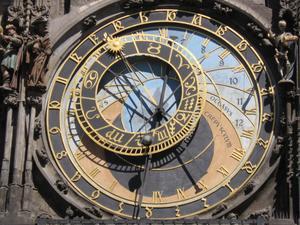
To reconcile the difference between Coordinated Universal Time (UTC) kept by atomic clocks and the earth's rotation, a leap second is being added on December 31, - On New Year's Eve, 2005, the clock will tick 23:59:59... 23:59:60... 00:00:00. The insertion of leap a leap second compensates for the very gradual deceleration of the earth's rotation. Since 1999, the accumulated differential is one second.
How does this affect GPS? According to the US Naval Observatory, GPS is not adjusted for leap seconds, and operates in the Epoch of January 6, 1980. As of New Year's Eve, GPS will be ahead of UTC by approximately 14 seconds.
Some historic leap seconds since 1980 are as tabulated as follows:
1980 JAN 1 =JD 2444239.5 TAI-UTC= 19.0 S + (MJD - 41317.) X 0.0 S
1981 JUL 1 =JD 2444786.5 TAI-UTC= 20.0 S + (MJD - 41317.) X 0.0 S
1982 JUL 1 =JD 2445151.5 TAI-UTC= 21.0 S + (MJD - 41317.) X 0.0 S
1983 JUL 1 =JD 2445516.5 TAI-UTC= 22.0 S + (MJD - 41317.) X 0.0 S
1985 JUL 1 =JD 2446247.5 TAI-UTC= 23.0 S + (MJD - 41317.) X 0.0 S
1988 JAN 1 =JD 2447161.5 TAI-UTC= 24.0 S + (MJD - 41317.) X 0.0 S
1990 JAN 1 =JD 2447892.5 TAI-UTC= 25.0 S + (MJD - 41317.) X 0.0 S
1991 JAN 1 =JD 2448257.5 TAI-UTC= 26.0 S + (MJD - 41317.) X 0.0 S
1992 JUL 1 =JD 2448804.5 TAI-UTC= 27.0 S + (MJD - 41317.) X 0.0 S
1993 JUL 1 =JD 2449169.5 TAI-UTC= 28.0 S + (MJD - 41317.) X 0.0 S
1994 JUL 1 =JD 2449534.5 TAI-UTC= 29.0 S + (MJD - 41317.) X 0.0 S
1996 JAN 1 =JD 2450083.5 TAI-UTC= 30.0 S + (MJD - 41317.) X 0.0 S
1997 JUL 1 =JD 2450630.5 TAI-UTC= 31.0 S + (MJD - 41317.) X 0.0 S
1999 JAN 1 =JD 2451179.5 TAI-UTC= 32.0 S + (MJD - 41317.) X 0.0 S
2006 JAN 1 =JD 2453736.5 TAI-UTC= 33.0 S + (MJD - 41317.) X 0.0 S
Technorati tags:
astronomy, gps, navigation, news, science, space, time
Subscribe to:
Posts
(
Atom
)

 Posts
Posts

